TekDex is a technology-driven consulting and engineering company. We build agentic AI, cloud-native platforms and ServiceNow solutions for enterprises worldwide.
Loading
TekDex is a technology-driven consulting and engineering company. We build agentic AI, cloud-native platforms and ServiceNow solutions for enterprises worldwide.


An agent is not a chatbot with extra steps. It plans, chooses tools, calls your systems and keeps going until a task is actually done — which means the hard parts are permissions, failure handling and knowing when to stop, not the prompt.
We build agents that operate inside real boundaries: an explicit tool list, scoped credentials, budget and step limits, and a human checkpoint wherever the blast radius justifies one. Then we prove it works against a fixed set of cases before it touches anything that matters.
Talk to us about this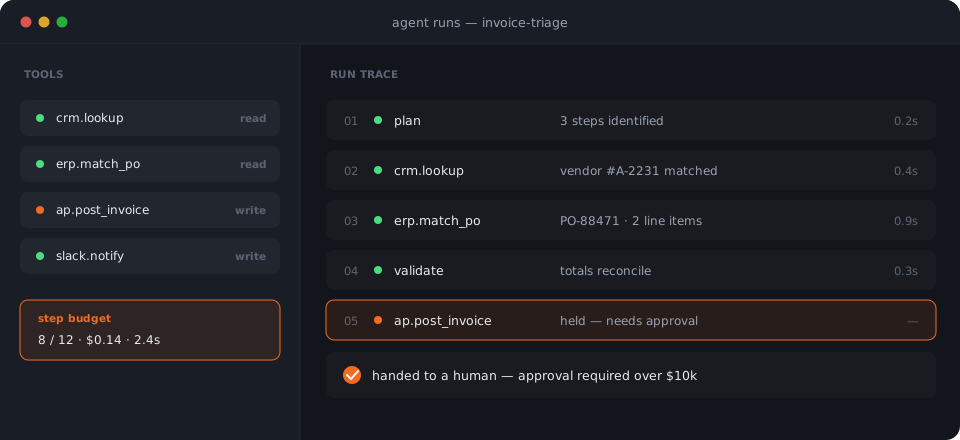
Three things every agent we ship comes with.
Agents fail in ways ordinary software does not: quietly, plausibly, and at 3am. So we instrument every run — the plan, the tool calls, the retries and the cost — and put that trace somewhere your team can read it without asking us.
Legal
Last updated 29 August 2026
This website is operated by TekDex. By browsing it or contacting us through it, you accept these terms. If you do not accept them, please do not use the site.
The site describes our consulting, engineering and talent services. Nothing on it is an offer capable of acceptance, a quotation, or a commitment to available capacity, timelines or price. Any engagement between us is governed solely by a separate signed agreement, and where that agreement conflicts with these terms, it prevails.
Articles, guidance and technical opinions published here are general in nature and are not professional advice for your situation. We take care to keep them accurate but make no warranty that they are complete or current, and you should not act on them without advice specific to your circumstances.
The content, design and code of this site belong to TekDex or its licensors. You may view, download and print pages for your own reference and share links to them. You may not republish, sell or systematically copy any part of the site without our written consent.
Third-party names, logos and trademarks shown on this site belong to their respective owners and are used only to describe the technologies we work with. Their appearance does not imply any endorsement, partnership or certification unless we state so explicitly.
Roles listed on the careers page are indicative and may be filled, changed or withdrawn at any time. Submitting an application creates no obligation on either side, and we may not be able to respond to every application individually.
Where we link to a third-party site, we do so for convenience. We do not control those sites and are not responsible for their content, availability or privacy practices.
We aim to keep the site available but do not guarantee uninterrupted access, and we may change or withdraw any part of it without notice. To the fullest extent permitted by law, we exclude liability for any indirect or consequential loss, loss of profit, or loss of data arising from your use of, or inability to use, this site. Nothing here limits liability that cannot lawfully be limited.
We may update these terms from time to time. The version published here is the one that applies, and the date above shows when it last changed.
Questions about these terms can go to consultations@tekdexinc.com.
Legal
Last updated 29 August 2026
This is a static marketing website. It does not run analytics, advertising or tracking scripts, it does not build a profile of you, and it does not sell or share personal data with advertisers.
We only receive personal information that you choose to send us:
The forms on this site do not post to a server. When you submit one, your browser opens your own email application with the details filled in — nothing reaches us until you press send there, and you can edit or abandon the message first.
To answer your enquiry, to assess your application, and to keep a record of our correspondence with you. We do not use your details for marketing unless you ask us to.
Enquiries are kept for as long as needed to deal with them and for a reasonable period afterwards. Applications are kept for the duration of the hiring process, and for up to twelve months afterwards in case a suitable role opens — unless you ask us to delete them sooner.
Your information is handled by the TekDex people who need it to reply to you or assess your application. We use standard business email and document services to do that, and we may disclose information where the law requires it. We do not sell personal data.
We do not set analytics, advertising or profiling cookies. Your browser may store limited technical data locally to make the site work; that data stays on your device.
You can ask us what personal information we hold about you, ask us to correct it, or ask us to delete it. Write to consultations@tekdexinc.com and we will respond within a reasonable period.
We take reasonable measures to protect the information you send us. No method of transmission over the internet is completely secure, so please do not send us confidential material, credentials or identification documents through this site.
If we change this policy, the updated version will appear here with a new date.
Questions? Email consultations@tekdexinc.com.